
How Much Snow Does Fort Collins Get? Winter Weather and What to Expect
How much snow does Fort Collins get? If you’re thinking about moving to Fort Collins — or buying a home here — this is one of the most common questions. The short answer: Fort Collins averages about 50–53 inches of snow per year, spread across a winter season that typically runs from late October through April.
But snowfall is only part of the story. Fort Collins winters are defined as much by sunshine as they are by snow — and understanding the full picture can help you plan your move, choose the right neighborhood, and know what to expect once you’re here.
Table of Contents
- Fort Collins Annual Snowfall Overview
- Month-by-Month Snowfall Breakdown
- How Fort Collins Snow Compares to Other Colorado Cities
- What Snow Looks Like in a Typical Fort Collins Winter
- What This Means for Residents and Homebuyers
- Winter Driving and Road Conditions
- Why Snow Is Part of Fort Collins’ Appeal
- Frequently Asked Questions
Fort Collins Annual Snowfall Overview
Fort Collins receives an average of approximately 51.4 inches of snow per year based on long-term climate data. Snow generally begins falling in late October or early November and can continue through April, with occasional late-season storms in May.
Despite the snowfall totals, Fort Collins benefits from 300+ days of sunshine per year — which means snow rarely lingers for long. Most storms are followed by sunny skies and rapid melting, especially on south-facing surfaces and roads.
| Metric | Fort Collins |
|---|---|
| Average Annual Snowfall | ~51.4 inches |
| Snow Season | Late October – April |
| Heaviest Snow Months | December – March |
| Average Winter High Temp | 40–48°F |
| Days of Sunshine per Year | 300+ |
Month-by-Month Snowfall Breakdown
Here’s a general idea of how snowfall is distributed across the winter season in Fort Collins:
| Month | Avg. Snowfall | What to Expect |
|---|---|---|
| October | 3–4 inches | Light, early-season dustings; often melts same day |
| November | 6–8 inches | First real accumulation; temps drop noticeably |
| December | 6–8 inches | Consistent cold; holiday snow common |
| January | 6–7 inches | Coldest month; dry, powdery snow |
| February | 5–7 inches | Continued cold; occasional warm spells |
| March | 9–11 inches | Often the snowiest month; heavy, wet storms |
| April | 7–9 inches | Late-season storms; rapid melt between events |
| May | 1–2 inches | Rare but possible; usually melts immediately |
Key takeaway: March is often Fort Collins’ snowiest month. Late-season storms can bring heavy, wet snow — but warm daytime temps typically melt it within a day or two.
How Fort Collins Snow Compares to Other Colorado Cities
Fort Collins sits at 5,003 feet elevation along the Front Range — lower than mountain towns but higher than many Midwestern or East Coast cities. Here’s how its snowfall compares:
| City | Avg. Annual Snowfall | Elevation |
|---|---|---|
| Fort Collins | ~51 inches | 5,003 ft |
| Denver | ~57 inches | 5,280 ft |
| Boulder | ~83 inches | 5,430 ft |
| Colorado Springs | ~40 inches | 6,035 ft |
| Breckenridge | ~300+ inches | 9,600 ft |
| Chicago | ~36 inches | 597 ft |
Fort Collins gets roughly the same snow as Denver but significantly less than mountain communities. And unlike Chicago or the Midwest, Fort Collins snow comes with abundant sunshine — meaning it melts faster and doesn’t create the same prolonged gray winters.
→ Related: How Far Is Fort Collins From Denver — What You Should Know
What Snow Looks Like in a Typical Fort Collins Winter
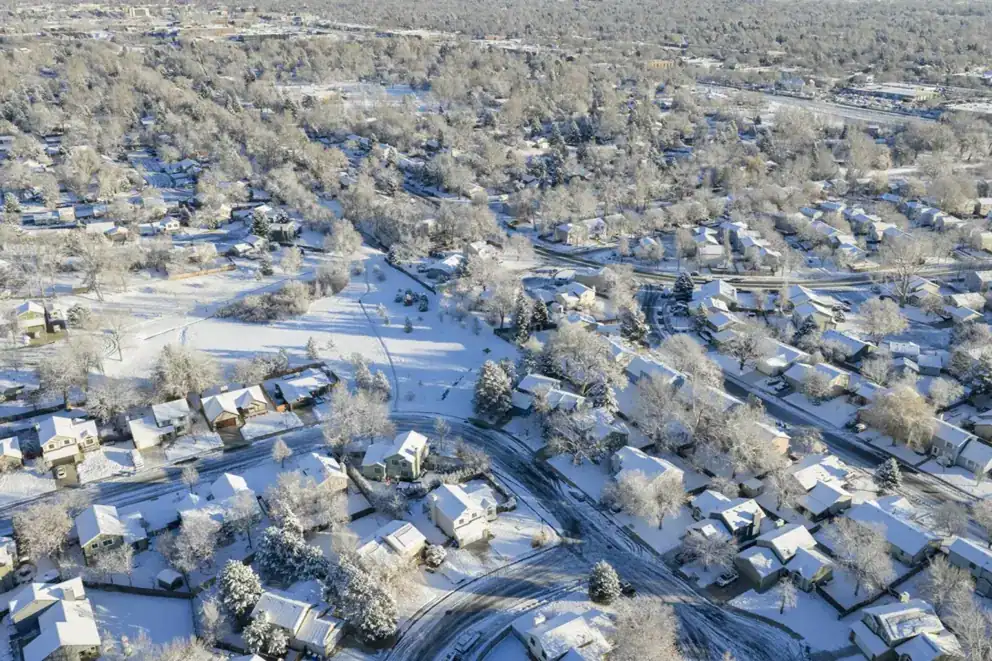
Most snow events in Fort Collins bring light to moderate accumulation — typically 2–6 inches at a time. A few larger storms each winter can bring 8–12+ inches, but these are the exception rather than the rule.
What makes Fort Collins winters distinct:
- Snow rarely lingers — Sunshine and dry air melt snow quickly, often within 24–48 hours
- Roads clear fast — City plowing is efficient, and main roads are typically clear by midday after a storm
- Dry, powdery snow — Fort Collins snow tends to be lighter and drier than Midwest or East Coast snow, making it easier to shovel and less likely to cause heavy ice buildup
- Warm afternoons between storms — It’s common to see 40–50°F daytime highs even in January and February
For people relocating from the Midwest or East Coast, Fort Collins winters often feel shorter, brighter, and more manageable than expected.
→ Related: The Pros and Cons of Living in Fort Collins
What This Means for Residents and Homebuyers
Winter in Fort Collins includes snow removal, colder temperatures, and occasional weather delays. But for most residents, winter is highly manageable — and even enjoyable.
For homebuyers, a few winter-specific considerations:
- Driveway orientation matters — South-facing driveways melt snow faster due to sun exposure
- Snow removal responsibilities — Most Fort Collins neighborhoods require homeowners to clear sidewalks within 24 hours of a storm
- Roof and gutter prep — Homes in good condition handle snow loads easily, but buyers should inspect roofing and drainage
- Neighborhood differences — West Fort Collins (closer to the foothills) can receive slightly more snow than areas in the south or east
The Levi Group is here to guide you through every detail — including helping you understand winter conditions in specific neighborhoods or around the homes you’re considering.
→ Related: Best Neighborhoods in Northern Colorado
→ Related: Map of Fort Collins Neighborhoods
Winter Driving and Road Conditions
Fort Collins handles snow well compared to many cities. The City of Fort Collins maintains a priority snow plowing system, and major roads like College Avenue, Harmony Road, and Shields Street are among the first to be cleared.
Tips for winter driving in Fort Collins:
- All-wheel drive or 4WD is helpful but not always necessary for in-town driving
- Good all-season or winter tires make a significant difference
- I-25 between Fort Collins and Denver can experience closures during major storms — check CDOT conditions before traveling
- Side streets and residential roads may take longer to clear after heavy snow
Most residents adapt quickly and find winter driving in Fort Collins straightforward compared to mountain or Midwest driving.
→ Related: How Far Is Fort Collins From Denver — What You Should Know
Why Snow Is Part of Fort Collins’ Appeal
Snow brings seasonal beauty and fun to Fort Collins — from sledding and winter walks to cozy indoor days. You’re also close to world-class ski resorts without needing to live at higher elevations.
Winter activities in and around Fort Collins include:
- Skiing and snowboarding at nearby resorts (Eldora, Copper Mountain, Winter Park)
- Snowshoeing and winter hiking in Horsetooth Mountain Open Space and Lory State Park
- Ice skating at local rinks
- Cross-country skiing on local trails
- Sledding at neighborhood parks and open spaces
Snow adds variety and character to Fort Collins while still allowing for an active, outdoor-centered lifestyle — even in the coldest months.
→ Related: Top 5 Winter Activities in Northern Colorado
→ Related: How to Get to the Best Ski Resorts From Fort Collins
→ Related: Ice Skating in Fort Collins This Winter
Frequently Asked Questions About Moving to Fort Collins
How much snow does Fort Collins get per year?
Fort Collins averages about 50–53 inches of snow per year, with the heaviest snowfall typically occurring between December and March. March is often the snowiest month.
Does Fort Collins get more snow than Denver?
No — Fort Collins and Denver receive similar snowfall totals (about 51 vs. 57 inches annually). However, Fort Collins sits at a slightly lower elevation and benefits from rapid snowmelt due to 300+ days of sunshine.
Do you need a 4WD vehicle in Fort Collins?
A 4WD or AWD vehicle is helpful during storms but not essential for everyday driving in Fort Collins. Good all-season or winter tires are usually sufficient for in-town travel. 4WD becomes more important for mountain driving or reaching ski resorts.
When does it start snowing in Fort Collins?
The first snow in Fort Collins typically arrives in late October or early November. Significant accumulation usually begins in November and continues through March or April.
How long does snow last on the ground in Fort Collins?
Snow rarely lasts more than a day or two in Fort Collins. With 300+ days of sunshine and dry Colorado air, most snow melts quickly — especially on roads and south-facing surfaces.
Is winter in Fort Collins harsh?
Compared to Midwest or East Coast winters, Fort Collins winters are sunny, dry, and manageable. Cold snaps occur, but extended gray, wet periods are rare. Most residents find winters shorter and more pleasant than expected.
~ By The Levi Group Brokered by Real ~
Your Personal Guide to Fort Collins

Thank you for visiting our blog dedicated to what it is like to live in Fort Collins Co. We created all this content with you in mind. This site has the most comprehensive content about Fort Collins Colorado. If you have any questions please don’t hesitate to reach out to us. We would love to visit with you and answer any questions you have.

Jason Levi
The Levi Group Brokered by REAL, LLC
Call Me: 970-426-8916
Text Me: 970-426-8916
Email Me: jason@thelevigroup.net
Stay Up to Date – Subscribe & Follow
Youtube Channel: @LeviGroupNoco
Facebook: Jason Levi
Instagram: @noco.jas
POPULAR POSTS
VIDEO ABOUT FORT COLLINS COLORADO
INSPIRATIONAL QUOTE
The Fort Collins Experience is your comprehensive guide to everything Fort Collins Colorado. Whether you’re searching for the best things to do, researching schools and neighborhoods, exploring local breweries and outdoor adventures, hunting for great restaurants and hotels, or staying up to date on Fort Collins real estate trends — you’ll find it all here in one place. This site was built with a single goal: to give you a genuine, firsthand understanding of what it’s really like to live in Fort Collins. As a longtime resident and full-time Realtor, I’ve walked these streets, explored these communities, and experienced every corner of this city. I share that local insight so you don’t have to spend hours piecing together scattered information like I once did. Whether you’re relocating, investing, raising a family, or simply curious, The Fort Collins Experience will show you why so many people are drawn to northern Colorado. Fort Collins isn’t just a location — it’s a lifestyle shaped by nature, community, creativity, and opportunity. If you’re ready to discover what makes Fort Collins Colorado one of the most desirable places to live in the state, you’re exactly where you need to be.